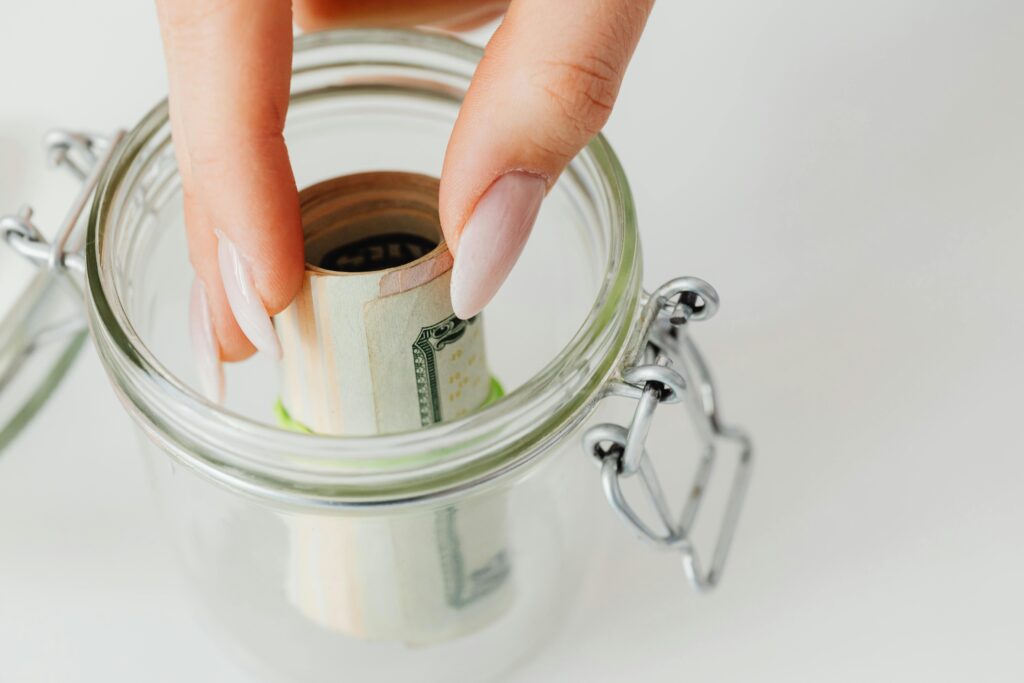
Two years ago saving $10,000 in a year felt completely impossible to me. I was living paycheck to paycheck, had no real budget, and thought people who saved that kind of money in a single year must be earning significantly more than I was. Then I met someone earning less than me who had just saved $12,000 in twelve months. She walked me through exactly how she did it and I realized the gap between us was not income. It was system. I followed her approach and saved $10,400 in my first year of trying. In this guide I share the complete plan so you can do the same.
Saving $10,000 in one year sounds like a lot. But when you break it down it becomes something completely achievable even on a modest income.
$10,000 per year is:
- $833 per month
- $192 per week
- $27 per day
Suddenly it sounds very different. Most people who cannot imagine saving $10,000 per year can imagine finding $27 per day. The question is not whether it is possible. The question is whether you have the right system in place to make it happen.
In this complete guide we show you exactly how to save $10,000 in one year step by step regardless of your current income or financial situation.
Is Saving $10,000 in One Year Realistic for You?
Before diving into the plan it is important to be honest about what is required. Saving $10,000 in one year requires $833 per month in savings. Here is what that looks like at different income levels:
| Monthly Take Home Income | Required Savings Rate |
|---|---|
| $2,000 per month | 42% of income |
| $2,500 per month | 33% of income |
| $3,000 per month | 28% of income |
| $3,500 per month | 24% of income |
| $4,000 per month | 21% of income |
| $5,000 per month | 17% of income |
For lower incomes reaching $10,000 in one year will require a combination of aggressive expense cutting and income growth through side hustles. For higher incomes it may simply require tightening the budget and automating savings.
Be honest with yourself. If $833 per month in savings is genuinely impossible with your current income and expenses the strategies in this guide will still significantly increase your savings even if the full $10,000 takes 18 months instead of 12. Progress matters far more than perfection.
Step 1: Open a Dedicated Savings Account
Before you save a single dollar open a dedicated savings account specifically for your $10,000 goal. This account should be:
Separate from your everyday banking:
Keeping your savings goal money in the same account as your spending money makes it far too easy to dip into. A completely separate account creates a psychological and practical barrier that protects your savings.
A high yield savings account:
Regular savings accounts earn almost no interest. High yield savings accounts currently offer 4 to 5 percent annual interest. On a growing balance of $10,000 that is $200 to $500 in free interest by year end. Use sites like NerdWallet to compare current high yield savings account rates.
Named after your goal:
Most online banks let you name your savings accounts. Name it something specific like “10K Goal 2026” or “House Down Payment” or “Emergency Fund.” Seeing your goal every time you log in reinforces your motivation.
Slightly inconvenient to access:
Choose an account at a different bank from your main checking account. The 1 to 3 day transfer delay makes impulsive withdrawals much less likely.
Step 2: Calculate Your Current Savings Gap
Before you can build a plan to save $10,000 you need to know exactly where you stand right now.
Calculate your monthly savings gap:
Take your monthly take home income and subtract all your current monthly expenses. The number left over is your current monthly savings capacity.
Monthly take home income:          $[your income]
Minus fixed expenses:              $[rent, bills, loans]
Minus variable expenses:           $[food, transport, etc]
Equals current monthly savings:    $[result]

Target monthly savings:            $833
Minus current monthly savings:     $[result]
Equals your monthly savings gap:   $[gap amount]
Your savings gap is the amount you need to either cut from expenses, earn from additional income, or a combination of both to reach your goal.
Step 3: Build Your $10,000 Savings Budget
Now build a budget specifically designed to hit $833 per month in savings. This means treating your savings contribution like a fixed bill that gets paid before anything else.
The $10,000 savings budget framework:
Go through every expense category and identify what you currently spend versus what you could realistically spend with some effort:
Housing:
If you rent this is usually fixed. If you own consider whether refinancing, renting a room, or other options could reduce this cost.
Food:
This is typically the biggest opportunity. Most people can reduce their food spending by $100 to $300 per month through meal planning, cooking at home more, and reducing dining out without feeling deprived.
Transport:
Review fuel costs, parking, public transport, and rideshare spending. Could you reduce trips, carpool, or use cheaper transport options a few days per week?
Subscriptions:
Do a full subscription audit. Cancel everything you do not actively use at least weekly. Most people find $50 to $150 in monthly subscriptions they can cut immediately.
Entertainment:
Reduce paid entertainment and replace with free alternatives. Libraries, free local events, home movie nights, and outdoor activities cost nothing.
Personal care:
Review haircuts, beauty treatments, gym memberships, and personal care products. Which of these could be reduced or replaced with cheaper alternatives?
Shopping and clothing:
Implement a shopping pause for non essential items. Buy second hand where possible. Challenge yourself to buy nothing new for 30 days.
Build your revised budget:
After reviewing each category build a revised monthly budget where the difference between income and expenses equals at least $833.
Step 4: Automate Your Savings on Payday
This is the single most important step in the entire guide. Automate your savings before you can spend the money.
How to set up automated savings:
- Log in to your bank account
- Set up an automatic transfer of $833 per month to your dedicated savings account
- Schedule the transfer for the same day you receive your paycheck
- If you are paid bi weekly set up a transfer of $417 on each payday
Why automation is non negotiable:
Every study on saving behavior shows that people who automate their savings save significantly more than those who manually transfer money at the end of the month. When you save what is left over after spending there is usually nothing left. When you save first and spend what remains you consistently hit your targets.
The automation removes willpower from the equation entirely. You never see the money in your spending account so you never miss it.
Step 5: Find $200 to $300 Extra Per Month
For most people cutting expenses alone will not be enough to reach $833 per month in savings. You also need to find additional income. Even $200 to $300 per month extra directed entirely to savings makes a massive difference.
Quick income boosters:
Sell things you own:
Go through your home and sell everything you have not used in the past 6 months on Facebook Marketplace, eBay, or OfferUp. Most homes have $200 to $1,000 worth of sellable items. Put every dollar directly into your savings account.
Overtime or extra shifts:
If your job offers overtime or extra shifts take them for the first few months of your savings challenge. Even 4 to 6 extra hours per week can add $200 to $400 per month.
Freelance your skills:
What do you know how to do that others will pay for? Writing, graphic design, web development, accounting, tutoring, translation, photography, social media management. Even one or two clients paying $100 to $200 per month closes most savings gaps.
Gig economy work:
Food delivery, rideshare driving, task based work, and grocery shopping services let you earn money in your spare time with complete flexibility. Many people earn $300 to $600 per month from a few hours of gig work per week.
Rent something you own:
A spare room, a parking space, a storage area, your car when you are not using it, or equipment you own. Passive rental income from things you already have is one of the fastest ways to increase monthly savings.
Cash back and rewards maximization:
Switch all your regular spending to a cash back credit card paid in full each month and use cash back apps like Rakuten for all online purchases. This can generate $50 to $150 per month in passive cash back with no change in what you buy.
Step 6: Your Month by Month $10,000 Plan
Here is exactly what to focus on each month to stay on track:
Month 1: Setup Month
- Open your high yield savings account
- Set up automatic transfers
- Do a full subscription audit and cancel unused services
- Sell items around your home
- Total target: $833 saved
Month 2: Expense Reduction Month
- Implement your new food and grocery budget
- Call your internet and phone provider to negotiate lower rates
- Set up cash stuffing or envelope budgeting for variable spending
- Total target: $1,666 saved
Month 3: Income Boost Month
- Start one side hustle or increase overtime
- Maximize cash back on all spending
- Total target: $2,499 saved
Month 4: Habit Consolidation Month
- Review progress and adjust budget where needed
- Challenge yourself with a mini no spend week
- Total target: $3,332 saved
Month 5: Midpoint Check
- Celebrate reaching $4,000 saved
- Reassess any areas where you are struggling
- Total target: $4,165 saved
Month 6: Halfway Milestone
- You should be at or near $5,000 saved
- Review your high yield savings account interest earned
- Recommit to the second half of the year
- Total target: $4,998 saved
Month 7: Momentum Month
- Add any tax refund, bonus, or windfall directly to savings
- Total target: $5,831 saved
Month 8: Challenge Month
- Try a full no spend month for discretionary categories
- Total target: $6,664 saved
Month 9: Review Month
- Check progress against target
- Identify final push strategies for the last quarter
- Total target: $7,497 saved
Month 10: Final Quarter Push
- Increase side hustle intensity for the final 3 months
- Total target: $8,330 saved
Month 11: Almost There
- Stay focused on the finish line
- Total target: $9,163 saved
Month 12: Goal Achieved
- You have saved $10,000 in 12 months
- Celebrate your achievement
- Plan what comes next
- Total target: $10,000 saved ✅
What to Do When You Fall Behind
Almost everyone falls behind their savings target at some point during a 12 month challenge. Here is how to get back on track:
Do not give up:
Missing your target for one month does not mean the goal is lost. Calculate exactly how much you are behind and spread the catch up amount over the remaining months.
Find a one time boost:
Sell something, pick up extra work, or do a no spend week to make up a shortfall quickly rather than letting it compound.
Adjust your timeline:
If $10,000 in 12 months proves genuinely unachievable with your current income aim for $10,000 in 15 or 18 months. The goal is still worth pursuing even if the timeline extends.
Review what went wrong:
Identify the specific expenses or situations that caused the shortfall and address them before the next month begins.
How to Supercharge Your Progress
These strategies can significantly accelerate your $10,000 savings goal:
Direct windfalls straight to savings:
Tax refunds, work bonuses, birthday money, inheritance, and any unexpected income go directly to your savings account before you have a chance to spend them. Many people save their entire $10,000 goal simply by directing windfalls to savings throughout the year.
Use the 24 hour rule for purchases:
Wait 24 hours before any non essential purchase. Most impulse purchases are forgotten within 24 hours. Those that survive the wait were probably genuine needs or desires worth spending on.
Find your biggest expense leak:
Most people have one spending category where the majority of their overspending occurs. Find yours and focus your energy there. A $200 per month reduction in your biggest leak is worth 3 months of finding $60 savings across 10 small categories.
Increase your savings rate with every raise:
Any time your income increases direct at least half of the increase to savings. This accelerates your goal while still improving your lifestyle.
Track your savings balance weekly:
Check your savings account balance every Sunday. Seeing the number grow is one of the most motivating things you can do to stay on track through a year long savings challenge.
What to Do With Your $10,000
Before you start saving decide exactly what your $10,000 is for. Having a specific goal makes every sacrifice feel worthwhile.
Emergency fund:
$10,000 fully funds a robust emergency fund for most people providing 3 to 6 months of expenses and genuine financial security.
House down payment contribution:
$10,000 is a meaningful contribution to a house down payment and can be the foundation of a multi year saving strategy for home ownership.
High interest debt elimination:
Putting $10,000 toward credit card debt at 20 percent interest saves $2,000 per year in interest charges. This is one of the highest guaranteed returns available anywhere.
Investment account:
$10,000 invested in a low cost index fund at a 7 percent average annual return grows to over $20,000 in 10 years and over $76,000 in 30 years without adding another dollar.
Business startup fund:
$10,000 is enough to start many small businesses or side hustles that could eventually replace your employment income entirely.
CONCLUSION:
Saving $10,000 in one year is not easy but it is completely achievable with the right system. The people who succeed are not the ones with the highest incomes. They are the ones who automate their savings, cut their biggest expenses, find creative ways to earn a little more, and stay consistent through the inevitable challenges that arise over a 12 month period.
Start today. Open your high yield savings account. Set up your first automatic transfer. And commit to one year of intentional saving that could completely change your financial future.
Twelve months from now you will either have $10,000 in savings and the habits that will keep building wealth for the rest of your life or you will wish you had started today.
Which category will you put your $10,000 toward? Share in the comments and let us know what you are saving for!
Frequently Asked Questions
Q: How much do I need to save per month to reach $10,000 in one year?
A: You need to save exactly $833 per month or approximately $192 per week to reach $10,000 in 12 months. If you are paid bi weekly that is $417 per paycheck. Setting up an automatic transfer of this amount on payday is the most reliable way to stay on track throughout the year.
Q: Can I save $10,000 in one year on a low income?
A: It depends on your specific income and expenses. On a lower income reaching $10,000 in 12 months typically requires both aggressive expense cutting and some form of additional income through a side hustle or overtime. If $10,000 in 12 months is genuinely not possible with your current income the same strategies will still help you save significantly more than you currently do and you may reach the goal in 15 to 18 months instead.
Q: Where should I keep my $10,000 savings?
A: In a high yield savings account at an online bank separate from your everyday banking. High yield savings accounts currently offer 4 to 5 percent annual interest which means your savings earn while you build them. Keeping the money in a separate account also reduces the temptation to dip into your savings for everyday spending.
Q: What if I have debt? Should I save $10,000 or pay off debt first?
A: It depends on the interest rate of your debt. Always save at least $1,000 as a starter emergency fund before aggressively paying debt. For high interest debt above 8 percent focus on paying that off before saving aggressively since the guaranteed return of eliminating high interest debt typically beats investment returns. For low interest debt below 5 percent saving and investing alongside debt payments often makes mathematical sense.
Q: What is the fastest way to save $10,000?
A: The fastest approach combines three things simultaneously: automating $833 per month in savings from your existing income, identifying and cutting your biggest expense categories, and generating additional income through a side hustle or selling items you own. People who direct a windfall like a tax refund or work bonus entirely to savings often reach $10,000 faster than expected. The combination of all these approaches rather than relying on any one strategy is what gets people to $10,000 the fastest.

Muhammad Mateen is a personal finance blogger and the founder of Simply Saving More. After struggling with budgeting and saving money for years Muhammad developed practical strategies that helped him take control of his finances. He created Simply Saving More to share these real world tested tips with everyday people who want to improve their financial lives. His content focuses on practical actionable advice that anyone can implement regardless of income level.